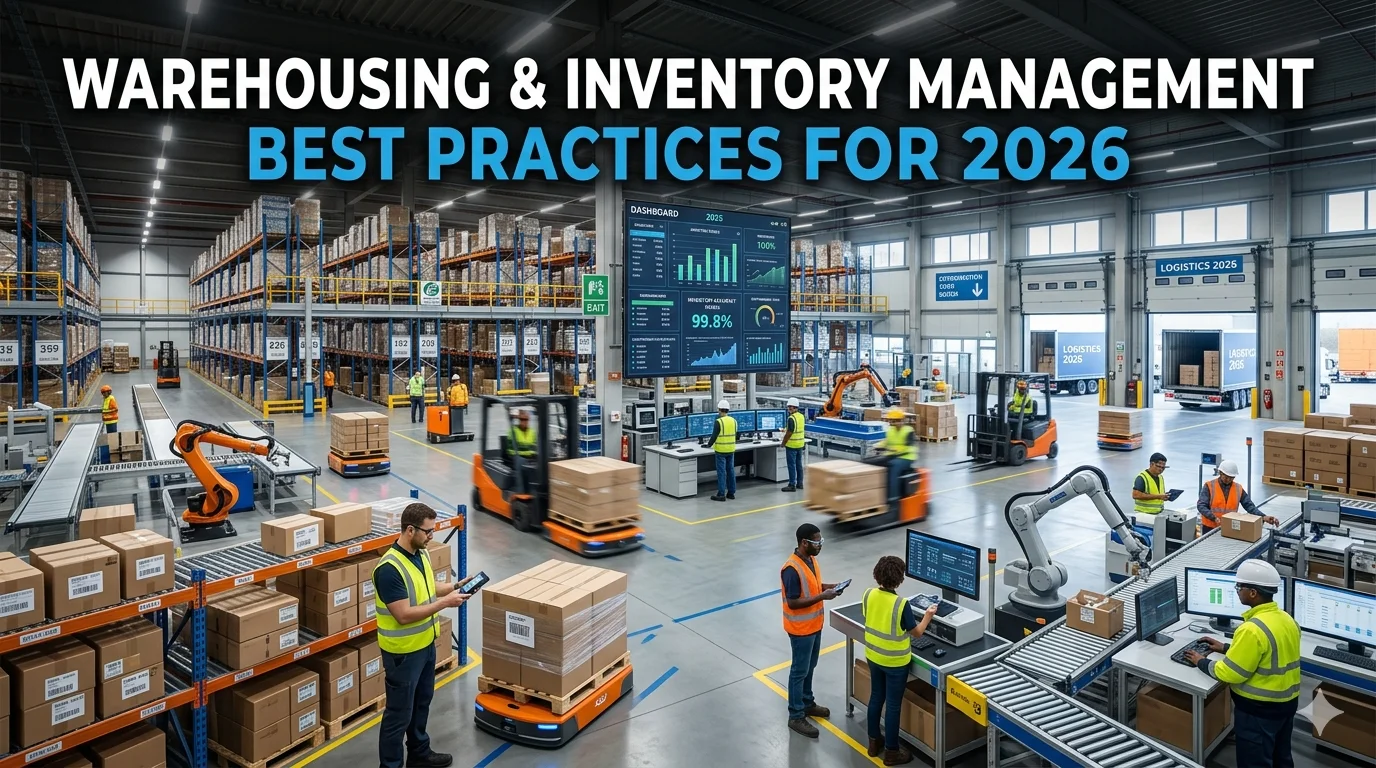
In today’s fast-paced global supply chain, efficient warehousing and inventory management are no longer back-office functions — they are strategic assets. As we move through 2026, businesses face rising customer expectations, volatile demand, and increasing pressure to reduce carrying costs. Modern warehouse operations must blend automation, data intelligence, and lean principles to remain competitive.
At Falcon Global Logistics, we help importers, exporters, and manufacturers design resilient supply chains — from smarter inventory controls to seamless freight forwarding. This guide explores the most impactful warehousing and inventory best practices to help you reduce costs, improve accuracy, and scale operations in 2026.
1. Implement a Cloud-Based Warehouse Management System (WMS)
Legacy spreadsheets and manual tracking lead to stock discrepancies and slow fulfillment. A modern cloud WMS provides real-time visibility into stock levels, bin locations, and order statuses. In 2026, AI-powered WMS platforms predict demand fluctuations and automate reorder points, reducing both stockouts and excess inventory.
Integration between your WMS and transportation management systems (TMS) ensures that inventory data flows directly into freight planning. For deeper insights into supply chain digitalization, read our analysis on The Future of Global Logistics: Digitalization and Resilience in 2026.
2. Adopt Cycle Counting Over Annual Physical Inventory
Annual shutdowns for full physical counts are disruptive and costly. Cycle counting — systematically counting subsets of inventory on a rotating schedule — improves accuracy without halting operations. Best-in-class warehouses achieve 98%+ inventory accuracy using daily or weekly cycle counts targeted at high-value or fast-moving SKUs.
Consistent inventory accuracy also improves demand forecasting and reduces costly emergency shipments. For strategies that balance cost and reliability, see our guide: How to Reduce Supply Chain Costs Without Sacrificing Reliability.
3. Slotting Optimization & Warehouse Layout Redesign
Product slotting — positioning items based on velocity, size, and weight — dramatically reduces travel time and pick errors. In 2026, dynamic slotting algorithms analyze real-time order data to suggest optimal storage locations weekly. Fast-moving items are placed near packing stations, while bulky or slow inventory goes to reserve zones.
An optimized layout also supports smooth integration with your ocean and air freight receiving. For exporters leveraging Sea Freight Services, a well-organized dock-to-stock process reduces container detention charges and improves throughput.
4. Leverage Automation & Robotics for High-Volume Warehouses
From autonomous mobile robots (AMRs) to goods-to-person (G2P) systems, automation reduces labor dependency and increases picking accuracy. Even mid-sized warehouses now deploy robotic arms for palletizing and automated guided vehicles for internal transport. The upfront investment is offset by lower operational costs and fewer errors.
Automation also complements air freight agility. Our Air Freight Services benefit from clients who maintain rapid cross-dock capabilities — made possible by automated sortation and real-time inventory sync.
5. Real-Time Inventory Visibility Across Multi-Node Networks
Modern supply chains involve multiple warehouses, 3PLs, and direct-to-customer fulfillment hubs. Siloed inventory data leads to overstocking or missed sales. A unified inventory visibility platform provides a single source of truth, enabling intelligent allocation decisions. In 2026, RFID, IoT sensors, and barcode scanning with cloud synchronization are standard.
For importers using import/export operations, real-time visibility reduces customs delays and improves compliance. Accurate inventory reporting also supports documentation required by customs authorities, as highlighted in Customs Clearance 2026: New Regulations for Pakistan Importers.
6. Sustainable Warehousing: Energy Efficiency & Green Materials
Sustainability initiatives reduce operational costs and meet partner expectations. Install LED lighting with motion sensors, solar panels, and high-speed dock doors to conserve energy. Electric forklifts and recyclable packaging materials further shrink the carbon footprint of your warehouse operations.
Our comprehensive approach to Reducing Carbon Footprint in Freight Forwarding includes warehousing strategies that align with global decarbonization goals. Combining green warehousing with optimized transportation creates a truly sustainable supply chain.
7. Cross-Docking & Flow-Through Distribution
Cross-docking eliminates long-term storage by transferring incoming shipments directly to outbound trucks. This best practice is ideal for high-volume, predictable SKUs and reduces handling costs, inventory carrying time, and warehouse space needs. In 2026, more distributors are adopting hybrid models with minimal storage zones.
For project cargo and specialized freight, cross-docking requires meticulous planning. Learn how heavy lifts are coordinated in our Heavy Lift Project Cargo Case Study.
8. Demand-Driven Replenishment & Safety Stock Optimization
Traditional fixed reorder points cause bullwhip effects. Demand-driven replenishment uses statistical forecasting, lead time variability, and service level targets to calculate dynamic safety stock levels. Advanced inventory optimization software automatically adjusts parameters based on actual consumption patterns and supplier performance.
Understanding your ocean freight lead times is critical here. Read our update on Ocean Freight Rate Trends: What Importers and Exporters Need to Know to factor in market volatility.
9. Integrate Inventory Planning with Multimodal Freight
Seamless integration between inventory planning and freight selection reduces costs. For example, slow-moving inventory can be shipped via ocean freight (LCL or FCL) while fast-turnover items use air freight for speed. That hybrid approach requires inventory segmentation and clear lead time agreements.
Our detailed comparison Air Cargo vs Ocean Freight: Speed vs Cost Analysis 2026 helps you choose the right mode per product type.
10. Staff Training & Continuous Improvement Culture
Technology alone isn’t enough. Invest in regular training for warehouse associates on WMS features, safety protocols, and lean principles. Empower team members to suggest process improvements — frontline workers often spot inefficiencies that managers miss. In 2026, successful warehouses adopt continuous improvement frameworks like Kaizen or Six Sigma.
For comprehensive customs and warehousing support in Pakistan, Falcon Global’s Clearing & Forwarding Team ensures your goods move from port to warehouse with full compliance and speed.
Building a Future-Ready Warehouse in 2026
The most competitive businesses view warehousing not as a cost center, but as a value driver. By adopting cloud WMS, real-time visibility, automation, and sustainable practices, you can lower inventory carrying costs, increase order accuracy, and respond faster to market shifts. At Falcon Global Logistics, we support your entire logistics ecosystem — from strategic inventory planning to reliable ocean freight, air cargo, and customs clearance.
Ready to upgrade your warehouse and inventory strategy? Explore more industry insights on our Logistics Blog or contact our team for tailored logistics solutions that combine warehousing best practices with world-class freight forwarding.