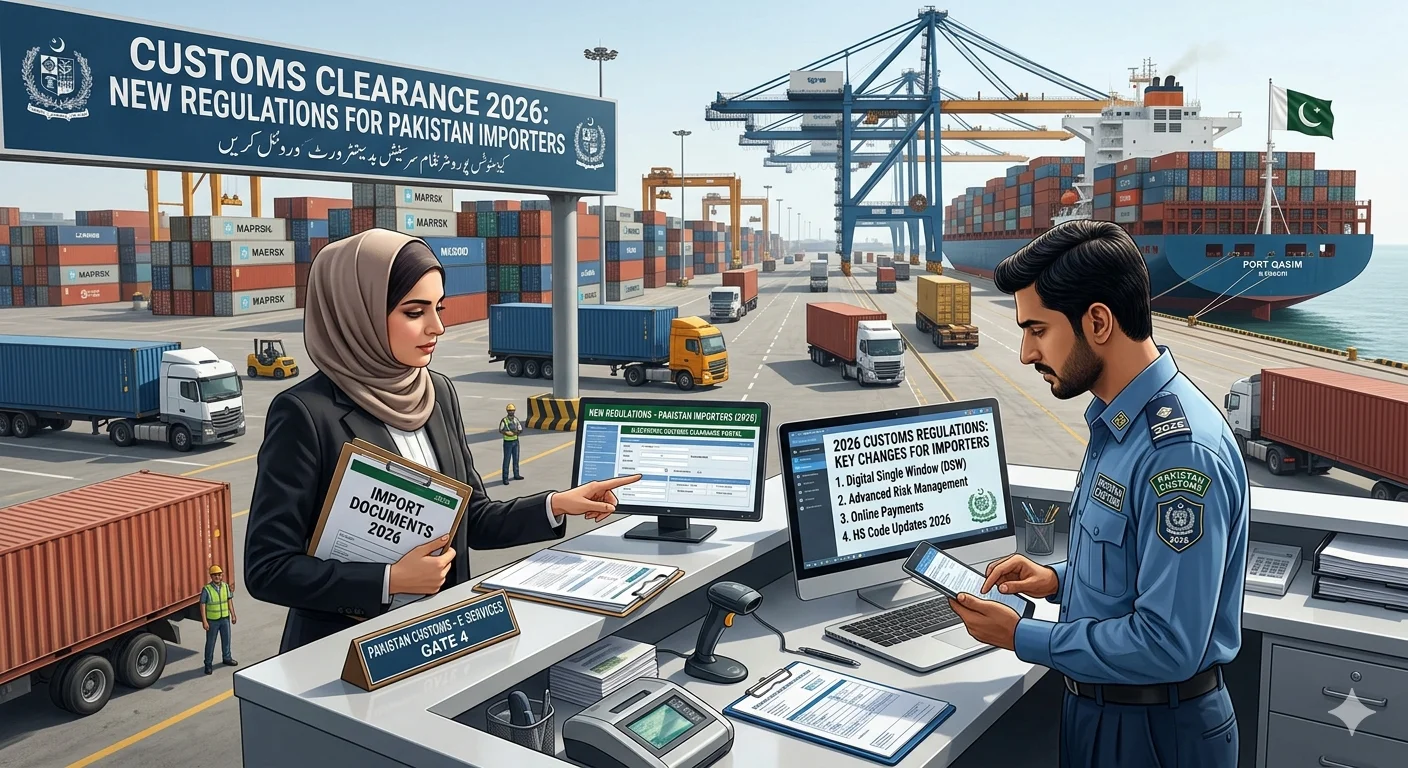
Pakistan's customs landscape is undergoing one of its most significant transformations in recent years. As global trade evolves and regulatory frameworks tighten, Pakistani importers must stay informed to avoid costly delays, penalties, and compliance failures. In this comprehensive guide, Falcon Global Logistics breaks down the key customs clearance changes in 2026 and what they mean for your business.
Understanding the 2026 Regulatory Landscape for Pakistani Importers
The Pakistan Customs authority, operating under the Federal Board of Revenue (FBR), has introduced sweeping updates to its digital and compliance infrastructure. These changes are in line with the World Customs Organization (WCO) framework and aim to reduce smuggling, improve revenue collection, and streamline legitimate trade. Businesses relying on manual or outdated processes will face significant friction at every checkpoint.
For importers sourcing goods from China, UAE, Europe, or the United States, understanding the new regulatory environment is no longer optional — it is a business necessity. Our clearing and forwarding experts are already helping hundreds of clients transition smoothly.
1. WeBOC System Upgrades & Mandatory EDI Integration
Pakistan Customs' Web Based One Customs (WeBOC) platform has received major functional upgrades in 2026. All importers are now required to submit electronic declarations through WeBOC before cargo arrives at the port. Manual paper submissions are being phased out entirely across Karachi Port Trust (KPT), Port Qasim, and Dry Ports.
Key changes include:
- Pre-arrival Processing (PAP): Goods Declaration (GD) filing must be completed before the vessel berths. Late or incorrect filings attract automatic penalties.
- Electronic Data Interchange (EDI): All shipping lines, freight forwarders, and customs agents must be EDI-compliant to exchange data with customs in real time.
- Single Window Integration: WeBOC is now integrated with multiple government agencies including PSQCA, DRAP, and the Ministry of Commerce, streamlining NOC and permit approvals within a single digital portal.
Failure to comply with WeBOC's upgraded requirements results in shipment holds and exam orders. Our team at Falcon Global ensures your documentation is accurate, complete, and submitted well within the mandated timelines. Learn more about our import/export services.
2. New HS Code Reclassifications & Valuation Rules
The FBR revised the Pakistan Customs Tariff (PCT) in alignment with the WCO's Harmonized System 2022 nomenclature updates. Dozens of product categories — including electrical machinery, textiles, chemicals, and food items — have been reclassified under new HS codes.
In addition, Pakistan Customs has implemented stricter transaction value scrutiny. Undervaluation of imported goods — particularly textiles, electronics, and consumer products from China — is now subject to automated cross-referencing against international trade databases. Importers must provide comprehensive commercial invoices, packing lists, and, in many cases, bank payment proofs to substantiate declared values.
3. Risk-Based Selectivity & Green Channel Expansion
Pakistan Customs has expanded its risk-based selectivity model across all major entry points. Shipments are now assessed using AI-assisted risk profiling and classified into three examination channels:
- Green Channel: Automatic release without physical examination. Reserved for compliant, low-risk importers with strong trade histories.
- Yellow Channel: Document verification only. No physical examination but full paperwork audit.
- Red Channel: Full physical examination. Triggered by anomalies in valuation, HS codes, or the importer's compliance record.
Maintaining a clean customs record, timely GD filings, and accurate declarations are now more important than ever to qualify for Green Channel status. Importers who frequently receive Red Channel exams face increased scrutiny and higher operational costs. As part of our clearing and forwarding services, Falcon Global proactively manages your compliance profile to maximize Green Channel clearances.
4. Authorized Economic Operator (AEO) Program Expansion
The Pakistan AEO program, which grants trusted trader status to compliant businesses, has significantly expanded in 2026. AEO-certified importers benefit from:
- Expedited customs clearance with reduced examination rates
- Priority processing during peak seasons and port congestion
- Mutual recognition arrangements (MRA) with customs authorities in China, UAE, and EU member states
- Reduced financial guarantees and bond requirements
Obtaining AEO certification requires a comprehensive internal audit of your supply chain, financial records, and security standards. While the process demands investment, the operational savings and competitive advantages make it worthwhile for high-volume importers. Contact our team to learn how we support AEO certification applications.
5. Import Policy Order (IPO) 2025-2026 Updates
The Ministry of Commerce released an updated Import Policy Order in late 2025, effective throughout 2026. For a deeper breakdown, read our guide to what changed in the Import Policy Order. Critical changes affecting Pakistani importers include:
- Negative List Revisions: Several items previously permitted for import under specific conditions have been moved to the negative list, including certain used machinery categories and specific chemical compounds. Always verify current IPO status before entering into supply contracts.
- Mandatory Product Standards: All imported consumer electronics, electrical appliances, and food products must carry PSQCA-approved quality marks or equivalents. Non-compliant goods are subject to rejection at the port.
- Restricted Items & Licensing: Pharmaceuticals, medical devices, and agrochemicals now require pre-import DRAP or DRAP-equivalent regulatory approval to be integrated into the WeBOC system before GD filing.
Understanding these policy boundaries is essential before finalizing any import transaction. Our import/export consultancy team conducts pre-shipment compliance checks to prevent costly surprises.
6. Port Digitization & Karachi Port Infrastructure Updates
Karachi Port Trust and Port Qasim Authority have both invested heavily in terminal operating system (TOS) upgrades, yard automation, and integrated gate systems. In 2026, all container movements are tracked digitally from vessel arrival to last-mile delivery, with automated demurrage and detention billing replacing manual processes.
Importers must now monitor port notifications in real time and act swiftly upon cargo arrival to avoid escalating demurrage charges. Delayed customs filings that previously attracted modest penalties now carry significantly higher financial consequences under the new automated billing systems.
As part of our ocean freight services, Falcon Global provides proactive arrival alerts and port liaising to protect your cargo from unnecessary detention. Explore our sea freight solutions for end-to-end port management.
7. Air Cargo Customs: Speed & Compliance for Time-Sensitive Shipments
For importers utilizing air freight, customs clearance at Karachi's Jinnah International Airport and Islamabad's New Islamabad International Airport has also been restructured. Air cargo GDs must be filed within 24 hours of aircraft arrival. Express consignments through courier channels are subject to de minimis value thresholds, with commercial shipments above PKR 50,000 requiring full GD processing.
Temperature-sensitive pharmaceutical and perishable shipments now benefit from dedicated fast-track lanes, but only when proper documentation — including import permits, health certificates, and cold chain compliance records — is pre-submitted. Our air freight team specializes in time-critical clearance for high-value and perishable cargo.
8. Anti-Dumping & Countervailing Duties: New Categories
The National Tariff Commission (NTC) has finalized anti-dumping duties on a fresh list of product categories in 2026, including certain steel products, ceramic tiles, and synthetic textiles primarily imported from China and India. Importers in these sectors must verify applicable ADD/CVD rates before shipment to accurately calculate landed costs.
Failure to account for anti-dumping duties results in significant unexpected costs at the time of clearance. Falcon Global's documentation team pre-screens all shipments for applicable trade remedy measures as part of our standard clearing service.
Preparing Your Business for Customs Compliance in 2026
Navigating Pakistan's evolving customs landscape requires a proactive, technology-driven approach. Here are the key steps every importer should take:
- Audit your existing HS code library and update classifications to WCO 2022 standards
- Ensure all suppliers provide commercial invoices that reflect actual transaction values
- Register with WeBOC and ensure your clearing agent is EDI-compliant
- Evaluate AEO certification eligibility with your clearing agent
- Review the IPO 2025-2026 for restrictions applicable to your product categories
- Build demurrage buffer time into your logistics planning
For a deeper look at how digitalization is reshaping the entire logistics chain — not just customs — read our related article on The Future of Global Logistics: Digitalization and Resilience in 2026.
How Falcon Global Logistics Supports Your Customs Strategy
At Falcon Global Logistics, our licensed customs clearing and forwarding team has been navigating Pakistan's regulatory environment for over 10 years. We provide:
- Pre-shipment HS code verification and valuation guidance
- WeBOC GD filing with real-time status monitoring
- AEO certification support and compliance audits
- Dedicated port liaison at KPT, Port Qasim, and major dry ports
- IPO compliance checks before import contracts are finalized
- Anti-dumping and trade remedy duty screening
Whether you are importing by sea or air, our integrated sea freight and air freight teams work seamlessly with our customs division to ensure your cargo clears without delays.
Curious how freight rates factor into your total import cost? Read our analysis on Ocean Freight Rate Trends: What Importers and Exporters Need to Know and our comparison of Air Cargo vs Ocean Freight: Speed vs Cost Analysis 2026.
The regulatory environment will continue to evolve. The importers who invest in compliance infrastructure today will gain a lasting competitive advantage through faster clearances, lower costs, and stronger relationships with customs authorities. Get in touch with Falcon Global Logistics to build a customs strategy that works for your business in 2026 and beyond.