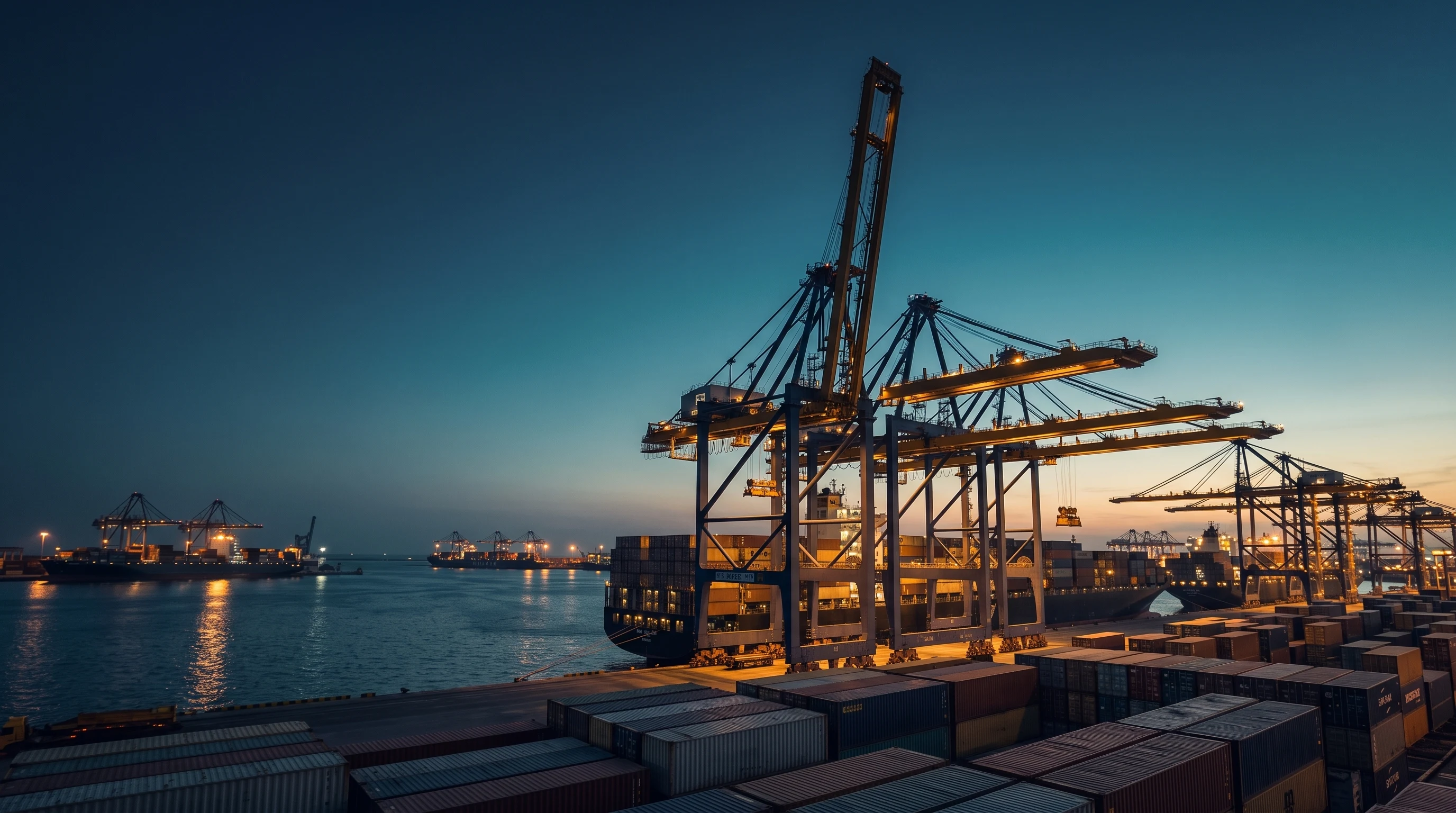
Karachi Port just recorded its highest ship-arrival count in eight years — 2,003 vessels berthed in the fiscal year ending June 2026, up 7.5% on the year before, with total cargo tonnage crossing 84.4 million tons. That's not the kind of number a port usually posts through organic growth alone, and it isn't. It's the direct result of a war thousands of kilometers away disrupting shipping across the Gulf, and global carriers quietly deciding that Pakistan is a safer, more convenient place to route cargo through in the meantime. At Falcon Global Logistics, we think this is one of the more consequential shifts in Pakistan's port sector this year — and also one that could reverse faster than most businesses are planning for.
The Numbers Behind the Headline
According to fiscal-year data covering July 2025 through June 2026, 2,003 ships berthed at Karachi Port — an eight-year high and a 7.5% increase in vessel arrivals compared to the previous fiscal year. Gross Registered Tonnage, the standard measure of a vessel's overall internal volume and a proxy for how much shipping capacity is actually calling at a port, rose 3% over the same period. Total cargo tonnage handled came in above 84.4 million tons. Port growth of a few percentage points a year is normal; an eight-year high arriving in a single fiscal cycle, tied to a specific geopolitical event, is not.
Why Carriers Are Suddenly Choosing Karachi
The driver is the Iran war and the disruption it has caused to shipping lanes across the Arab Gulf. When transit through a region carriers have relied on for decades becomes unpredictable, shipping lines don't stop moving cargo — they reroute it, and Pakistan has become one of the beneficiaries of that rerouting. Karachi's geographic position outside the immediate conflict zone, combined with existing container-handling infrastructure at its terminals, made it a practical alternative for lines that needed somewhere stable to transship cargo while the situation in the Gulf remained unsettled.
Islamabad Moved Fast: The March 2026 Rule Change
This wasn't purely accidental good fortune for Pakistan's ports — there was a deliberate policy response behind it. In March 2026, Pakistan revised its international transshipment rules to allow transshipment cargo to be handled both within and outside the country's sea and air ports, widening the range of facilities that can legally process this kind of traffic. That's a meaningful change: it signals that authorities recognized the opportunity in real time and moved to remove a regulatory bottleneck that could otherwise have capped how much of this rerouted volume Karachi could actually absorb.
Karachi vs. the Established Transshipment Hubs
Pakistani ship agents are now talking about something more ambitious than riding out a temporary bump — they see a chance to establish Karachi as a lasting transshipment hub, competing on port tariffs against the region's established players: Dubai, Salalah, Colombo, India's major ports, and Hong Kong. That's a serious list of competitors, each with decades of purpose-built transshipment infrastructure and long-standing carrier relationships. Karachi's opening is real, but it's an opening, not a settled position.
| Hub | Position vs. Karachi | What Karachi Is Betting On |
|---|---|---|
| Dubai (Jebel Ali) | Long-established regional leader | Competitive port tariffs, Gulf-conflict detour advantage |
| Salalah, Oman | Established Gulf-adjacent hub | Comparable geography, newer rule flexibility |
| Colombo, Sri Lanka | South Asia's dominant transshipment hub | Wider sea/air handling under new rules |
| Hong Kong | Established Far East hub | Not directly competing lane; different trade corridor |
The Catch: A Peace Deal Could Undo This Fast
Here's the part of the story that gets less attention than the record numbers: reports of a U.S.-Iran peace deal have already surfaced, and if Gulf shipping conditions normalize, global carriers have every incentive to revert to their traditional routing through the established Gulf hubs they know best. Pakistan's current advantage exists specifically because the usual routes became less attractive — it isn't (yet) built on Karachi out-competing Dubai or Colombo on cost and service quality alone. If the underlying disruption resolves, some of this rerouted volume could move on just as quickly as it arrived.
What This Means for Importers and Exporters Right Now
- Ask your freight forwarder which carriers are calling Karachi as part of this transshipment surge and whether that creates a temporary opportunity for more direct routing or better space availability on your specific lane.
- Don't assume current transit times are locked in. A port absorbing an unusual volume spike can either improve your options (more sailings, more competition for cargo) or strain clearance and yard capacity — the reality varies terminal by terminal.
- Watch geopolitical developments in the Gulf as closely as you watch freight rates. We've tracked this pattern before in our coverage of how the Red Sea crisis affected Pakistan importers and the Suez Canal's reopening status — regional shipping disruptions and their resolutions move fast, and routing decisions made mid-crisis often need to be revisited within months, not years.
- If your business has cargo that could plausibly transship through Karachi, this is a reasonable window to explore it with your forwarder, while the policy environment and carrier interest are both actively favorable.
Our ocean freight team tracks carrier routing decisions and Karachi Port capacity in real time, and our clearing and forwarding specialists help clients take advantage of shifts like this one without overcommitting to routing that may not hold up once regional shipping patterns normalize. For more on how record port activity is already affecting clearance timelines, see our recent look at Karachi Port's record cargo volumes and connectivity gains.
Conclusion: A Window, Not Yet a Destination
Karachi's eight-year-high ship-arrival numbers are a genuine, measurable win for Pakistan's port sector, and the March 2026 transshipment rule change shows Islamabad is serious about trying to capture something more durable out of it. But the honest read is that this moment was created by a regional conflict, not by Karachi decisively out-competing Dubai, Salalah, or Colombo on cost and reliability. Whether Pakistan converts this into a lasting transshipment hub — or watches the volume drift back to traditional routes once the Gulf stabilizes — will depend on what gets built and fixed in the months this window stays open.
At Falcon Global Logistics, we help importers and exporters make sense of exactly this kind of fast-moving shift, so your routing decisions are based on where the market actually is, not where it was a month ago. Contact us today to review your Karachi Port routing options while this window is open.