
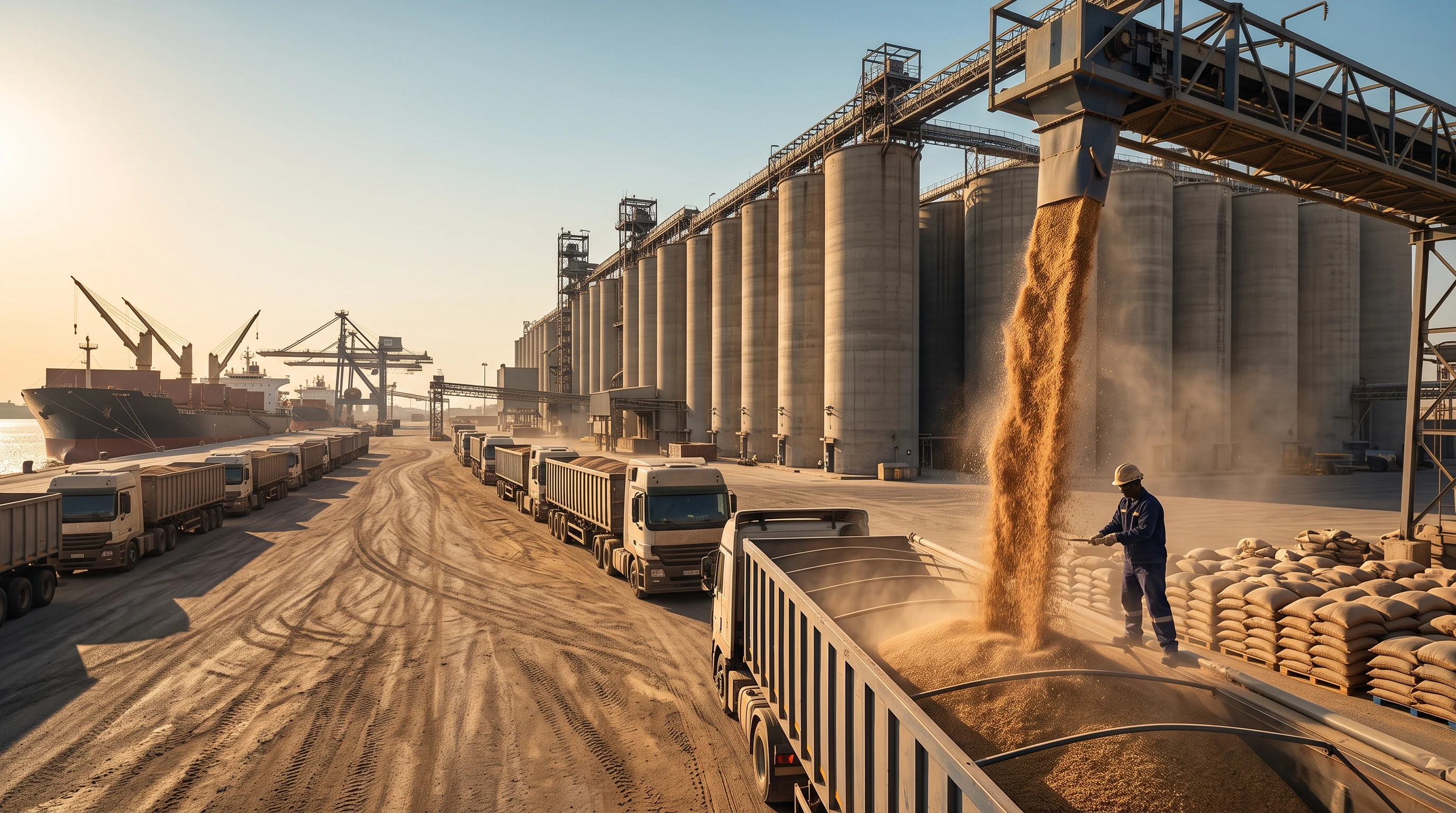
Flour prices are surging across Khyber Pakhtunkhwa and Balochistan right now — a 20kg bag has climbed past Rs 3,000 in parts of Shangla, and traders in Quetta are pricing 50kg bags at roughly Rs 7,500. The instinctive assumption is that Pakistan is running out of wheat. It isn't, or at least not in the way most people think. This is, at its core, a transportation and distribution failure — and at Falcon Global Logistics, that distinction matters enormously for how importers and cargo owners should think about supply chain risk in Pakistan right now.
The Import Side: A Tender That Came Up Short
Pakistan's Trading Corporation recently ran a tender for 750,000 tons of wheat to help stabilize supply. Nine international suppliers submitted offers, but their combined bids totaled only 656,000 tons — leaving nearly 94,000 tons of the tender uncovered at the offered price range of roughly $348.83 to $369.95 per ton. Open-market wheat prices have stabilized around $451 per ton following import preparations, but market participants are describing the likely outcome bluntly: this import volume may prevent another price spike, but there's "little scope for a sharp decline." With Pakistan's daily wheat processing running around 70,000 tons, a 750,000-ton import is real relief, but it's measured in weeks, not a structural fix.
The Real Story: A Domestic Logistics Breakdown
The sharper, more immediate driver of the price spikes in KP and Balochistan isn't the international wheat market at all — it's what's happening inside Pakistan's own borders. Traders in Shangla are pointing directly at "alleged restrictions or hurdles imposed by the Punjab government on the inter-provincial transportation and trade of wheat and flour," with some citing constitutional concerns under Article 151 regarding free movement of essential goods between provinces. In Balochistan, officials attribute the price surge to "reported disruptions in the movement of wheat and flour from Punjab and Sindh" — the country's two main wheat-producing provinces.
In other words: Punjab and Sindh have wheat. Khyber Pakhtunkhwa and Balochistan don't have enough of it reaching them. That's not a production shortfall — it's a supply chain that has a single point of failure at the provincial border, and when that single point gets restricted, entire regions feel it within days, not months.
| Region | Reported 20kg Flour Price | Primary Cause Cited |
|---|---|---|
| Shangla, KP | Rs 2,950–3,000+ (higher in remote areas) | Inter-provincial transport restrictions, fuel costs |
| Quetta, Balochistan | ~Rs 3,000 (20kg); ~Rs 15,000 (100kg) | Disrupted wheat/flour movement from Punjab & Sindh |
| National open market | ~$451/ton wheat (stabilizing) | Import tender partially covering supply gap |
Why This Matters Beyond Flour
This crisis is a useful, if painful, case study for anyone moving essential or bulk commodities in Pakistan. A supply chain concentrated through a small number of provincial corridors is fragile by design — a single administrative restriction, a fuel price spike, or a documentation bottleneck at one checkpoint can cascade into regional shortages within a week, regardless of how much product exists nationally. This is exactly the kind of risk we plan around for clients moving bulk agricultural and essential cargo: redundancy in routing, multiple transportation modes, and real-time visibility into where a shipment actually is versus where it's assumed to be.
For businesses importing wheat, grain, or other essential commodities — whether through Karachi Port or overland routes — the lesson from this crisis is the same one we've highlighted in our coverage of Karachi Port's record cargo volumes: getting cargo into the country is only half the supply chain. The domestic leg — clearing, warehousing, and onward transportation to the region that actually needs it — is where breakdowns like this one actually happen.
What Importers and Cargo Owners Should Do Now
- Diversify inland transportation partners and routes for any commodity that depends on inter-provincial movement, rather than relying on a single corridor or single carrier relationship.
- Track regulatory and administrative signals, not just port and customs data. This crisis originated from a provincial-level transport restriction — the kind of disruption that rarely shows up in standard freight-tracking tools until it's already affecting prices.
- Build buffer stock for essential commodities in regions with historically thinner supply corridors, particularly Balochistan and KP, where this pattern has now shown up more than once this year.
- Treat an undercovered international tender as an early warning, not a settled outcome. When global suppliers don't fill an order at the offered price, plan for continued price pressure rather than assuming the gap is closed.
Our clearing and forwarding team works with importers of bulk and essential commodities to build exactly this kind of routing redundancy into their supply chains, so a single provincial bottleneck doesn't become a company-wide crisis.
Conclusion: A Logistics Crisis Wearing a Supply Crisis's Clothes
Pakistan's flour prices are climbing not because the country lacks wheat, but because the wheat that exists isn't reaching every region reliably. That distinction should reshape how any business handling essential or bulk cargo in Pakistan thinks about risk — the fragility isn't necessarily upstream at the point of production or import, it's in the domestic corridors that carry goods the final distance to the people who need them.
At Falcon Global Logistics, we build supply chain resilience into every import and clearing arrangement we manage — because reliable logistics is what turns available supply into delivered supply. Contact us today to build a more resilient import and distribution plan for your essential cargo.