
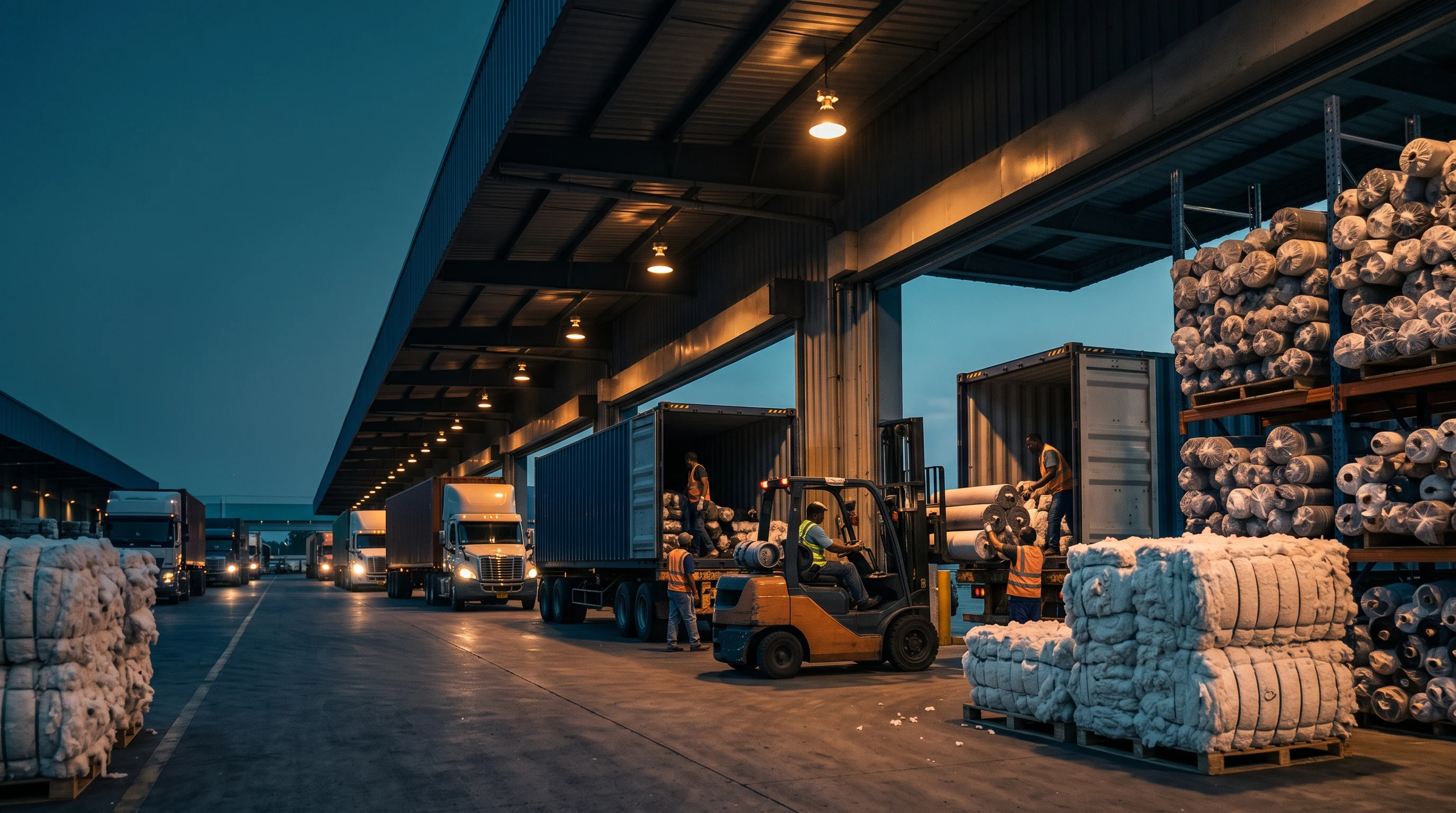
Pakistan's textile and apparel sector just posted its best export year in four: $18 billion for FY2025-26. On paper, that's the headline. The more interesting story is what's sitting underneath it — overall Pakistani exports actually fell 5.9% to $30.14 billion this year, which means textiles didn't just grow, they grew while everything else around them contracted, and now account for nearly 60% of the country's entire export base. At Falcon Global Logistics, that concentration is exactly the kind of number worth sitting with, because it tells you where the freight demand in this country is actually concentrated, and where the risk sits if anything in this sector slips.
A Four-Year High, Unevenly Spread
The overall growth number is modest — textile and apparel exports rose just 0.3% year-on-year to reach that $18 billion figure. But averages hide the real movement. Non-knit apparel hit a record $4.295 billion, up 3.9%. Within that category, men's cotton trousers rose 19% and women's cotton trousers surged 54%. Home textiles and made-ups reached $5.705 billion (+0.6%), and the broader apparel and made-ups category (covering HS chapters 61 through 63) totaled $14.98 billion, up 1.1%. Knitwear, by contrast, slipped 0.7% to $4.979 billion. The pattern is a sector reshuffling toward higher-value cut-and-sew apparel rather than growing uniformly across the board.
The Segment That's Actually Shrinking
The category to watch isn't a finished-goods line at all — it's raw materials and intermediate products, which fell 3.4% to $3.03 billion, a five-year low. That's not a demand problem. It's a supply problem, and it's the real story behind this whole report.
The Catch: A 30-Year Low in Cotton Production
Pakistan's cotton crop for the year came in at just 5.5 million bales — the lowest output in three decades, and a steep drop from the 14.8 million bales the country was producing back in 2011-12. Pakistan Textile Council CEO Muhammad Hassan Shafqat put it plainly: the sector's modest export increase "demonstrated the sector's ability to remain competitive in global markets," but cotton availability remains "a major concern." Read those two statements together and the picture is clear — mills are still filling export orders, but increasingly on the back of imported cotton and yarn rather than the domestic crop that used to supply them. This isn't a one-season blip; a 30-year production low reflects a structural shift in domestic agriculture, not a bad harvest that reverses itself next year.
Industry Leadership Is Naming Freight as a Bottleneck
What makes this report particularly relevant for anyone in freight forwarding is that the industry's own recommendations went straight at logistics. The report explicitly called for "competitive freight rates, shorter transit times and greater capacity for the Pakistan National Shipping Corporation." That's not an outside observer's opinion — that's the textile sector's own trade body naming shipping capacity and freight cost as a constraint on sustaining this export performance, in an official industry report.
| Export Market | FY26 Value | Trend |
|---|---|---|
| European Union | $7.103 billion | Largest market, slightly down from $7.248B |
| United States | $4.853 billion | Rising |
| United Kingdom | $1.730 billion | Stable |
| China | $644 million | Increased |
The market mix is worth noting alongside the freight story: the EU is still Pakistan's largest textile export destination by a wide margin, but it dipped slightly this year, while the US continued climbing. A shift like that changes which shipping lanes carry the growth — US-bound capacity and transit reliability matters more this year than it did the year before.
What This Means for Exporters and Importers Right Now
- If you're exporting apparel or made-ups, book freight capacity ahead of your production cycle, not at the point of shipment. With the sector's own trade body flagging freight rates and PNSC capacity as constraints, assume this lane gets more competitive before it gets easier.
- If your business imports cotton, yarn, or textile raw materials, treat this as a structural, multi-year opportunity rather than a one-off. A 30-year production low doesn't reverse in a single season, and mills that need imported input consistently need a reliable clearing and import partner just as consistently.
- Diversify carrier relationships rather than relying on a single shipping line, particularly if PNSC capacity is genuinely constrained as the industry report suggests — redundancy in carrier options is cheap insurance against a capacity squeeze.
- Watch the US-bound lane specifically. Growth is shifting there while the EU dips slightly, and transit reliability on that route is becoming more commercially important than it was twelve months ago.
Our ocean freight team works with apparel and textile exporters to lock in capacity ahead of demand cycles rather than reacting to rate spikes, and our import/export specialists support cotton, yarn, and raw-material importers who are increasingly central to keeping Pakistan's largest export sector supplied. This builds directly on the broader push we covered in Pakistan's export-led growth directive, which specifically named textiles as a priority sector — this report is the hard data showing what that priority actually looks like on the ground.
Conclusion: A Record Built on a Widening Gap
Pakistan's textile sector delivered a genuine, four-year-high export performance in FY26, and that's worth recognizing. But the honest read is that this record was achieved despite a 30-year low in domestic cotton production, not because of favorable input conditions — and the sector's own leadership is telling anyone who'll listen that freight capacity and cost are now part of what determines whether this growth holds. For exporters and raw-material importers alike, that's a clear signal to plan logistics around where this sector is actually headed, not just where it's been.
At Falcon Global Logistics, we help textile exporters and cotton/yarn importers plan freight around real sector data, not assumptions. Contact us today to secure your export or import freight capacity for the season ahead.