
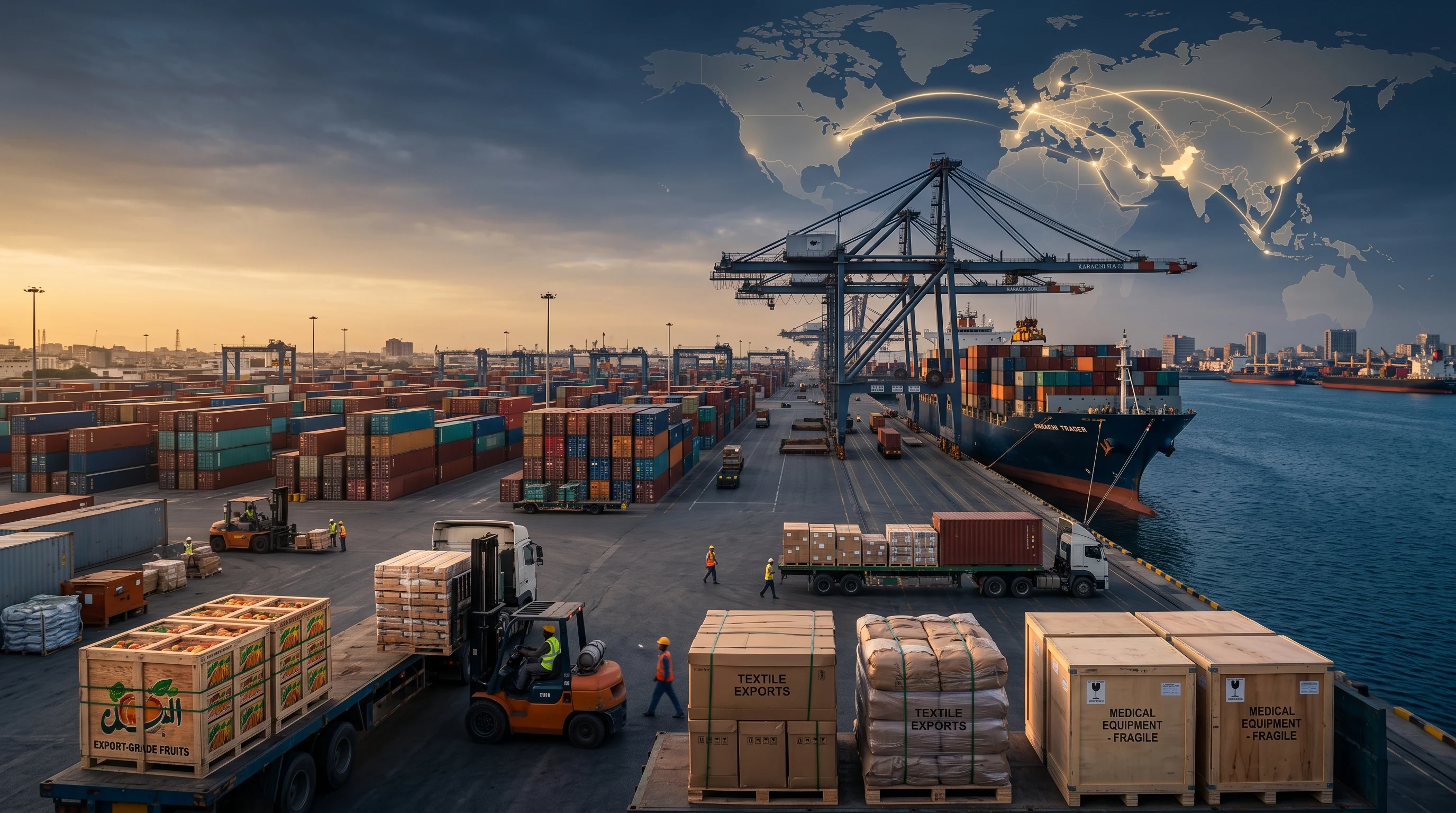
Pakistan's export policy conversation just shifted gears. On September 16, Prime Minister Shehbaz Sharif directed the federal government to place export expansion at the center of the country's economic strategy — with specific instructions on quality standards, market diversification, and sector-level support. For exporters, the headline is welcome. For the freight and logistics side of the equation, it's a signal that the sectors being pushed hardest each carry very different shipping requirements. At Falcon Global Logistics, we work across all three of the named priority sectors daily, so here's what the directive actually means on the ground.
What the PM's Directive Actually Covers
Rather than a single new policy, this is a set of directives aimed at broadening participation in exports across industries and diversifying Pakistan's trade portfolio. The core instructions include:
- Alignment with international quality benchmarks — stronger quality assurance systems and full regulatory compliance, positioned as a precondition for competing in higher-value markets.
- Value addition as a competitiveness lever — a push to export more processed, finished, and branded goods rather than raw or semi-finished materials.
- New free trade and preferential trade arrangements — described as under negotiation with "several friendly countries," aimed at improving market access for Pakistani products, though specific countries were not named in the announcement.
- A restructured, now-operational Export Development Fund (EDF) — intended to channel support more directly to exporters.
- Procedural simplification — removing bureaucratic obstacles in the export process, alongside deeper digitalization of trade-related systems.
Three Named Sectors, Three Very Different Freight Profiles
The announcement specifically named horticultural products, surgical and medical equipment, and textiles as priority areas — and each one moves through an entirely different logistics chain. Treating them as one generic "exports" category is exactly the mistake this new push is trying to move past.
| Sector | Typical Freight Mode | Key Logistics Requirement |
|---|---|---|
| Horticultural Products | Air freight / reefer sea freight | Cold chain integrity, fast customs clearance, perishability-driven deadlines |
| Surgical & Medical Equipment | Air freight (priority), sea for bulk orders | Certification & compliance documentation, careful handling, tender-deadline reliability |
| Textiles | Sea freight (FCL/LCL) | Consistent transit scheduling, container availability, cost-efficiency at volume |
Horticulture is the most time-sensitive of the three: fresh produce exports live or die on transit speed and unbroken cold chain, which is why we route most perishable export bookings through air freight or temperature-controlled sea freight rather than standard ocean transit. Surgical and medical equipment carries the heaviest documentation burden of the three — international hospital tenders and procurement processes typically require certifications, conformity paperwork, and traceability that has to be flawless before the shipment ever reaches a port or airport. Textiles remain the highest-volume, most cost-sensitive category, which keeps them firmly in ocean freight territory, where container availability and consistent transit scheduling matter more than raw speed.
Why the "Friendly Countries" Trade Arrangements Matter for Routing
The directive references free trade and preferential arrangements being developed with unnamed partner countries. Whichever markets this ultimately covers, new or improved trade access typically changes the *volume and frequency* of shipments to those destinations before it changes anything else — which means routing and carrier capacity planning needs to happen well ahead of the paperwork being finalized, not after. Exporters who wait for a trade agreement to be publicly confirmed before discussing freight capacity with their forwarder are often the ones scrambling for space once demand actually shifts.
This mirrors what we're already seeing on the industrial policy side more broadly — see our related coverage of Pakistan's New Industrial Policy 2026 for how tariff rationalization and investment targeting are reshaping which markets are worth building freight relationships with now.
What This Means for Exporters Planning Right Now
- If you're in horticulture: lock in reliable cold-chain freight capacity ahead of peak season rather than booking reactively — quality-standard compliance is only half the battle if the shipment doesn't arrive in sellable condition.
- If you're in surgical/medical equipment: get your certification and compliance documentation audited now. Tender-based export opportunities move fast once they're won, and paperwork delays at the freight stage are the most common reason a winning bid still misses its delivery window.
- If you're in textiles: use the EDF restructuring and simplified procedures as an opportunity to review your current freight contracts — cost efficiency at volume is where this sector wins, and that means it's worth re-shopping FCL/LCL rates now rather than defaulting to your existing arrangement.
- Across all sectors: ask your freight forwarder directly whether they have existing capacity and documentation experience in the specific new or growing markets you're targeting — not just in your traditional destinations.
Conclusion: A Policy Push That Rewards Freight Planning, Not Just Compliance
Quality standards and value addition get the headlines, but the businesses that benefit most from this export-led growth push will be the ones who treat freight and logistics planning as part of their export strategy from day one — not as an afterthought once an order is confirmed. Whether your product moves by air, reefer, or standard ocean freight, the sectors named in this directive all share one thing in common: the export opportunity only becomes revenue once the shipment actually clears and arrives.
At Falcon Global Logistics, we support exporters across horticulture, medical equipment, and textiles with freight solutions built around each sector's specific requirements. Contact us today to plan your export freight strategy around this new push.