
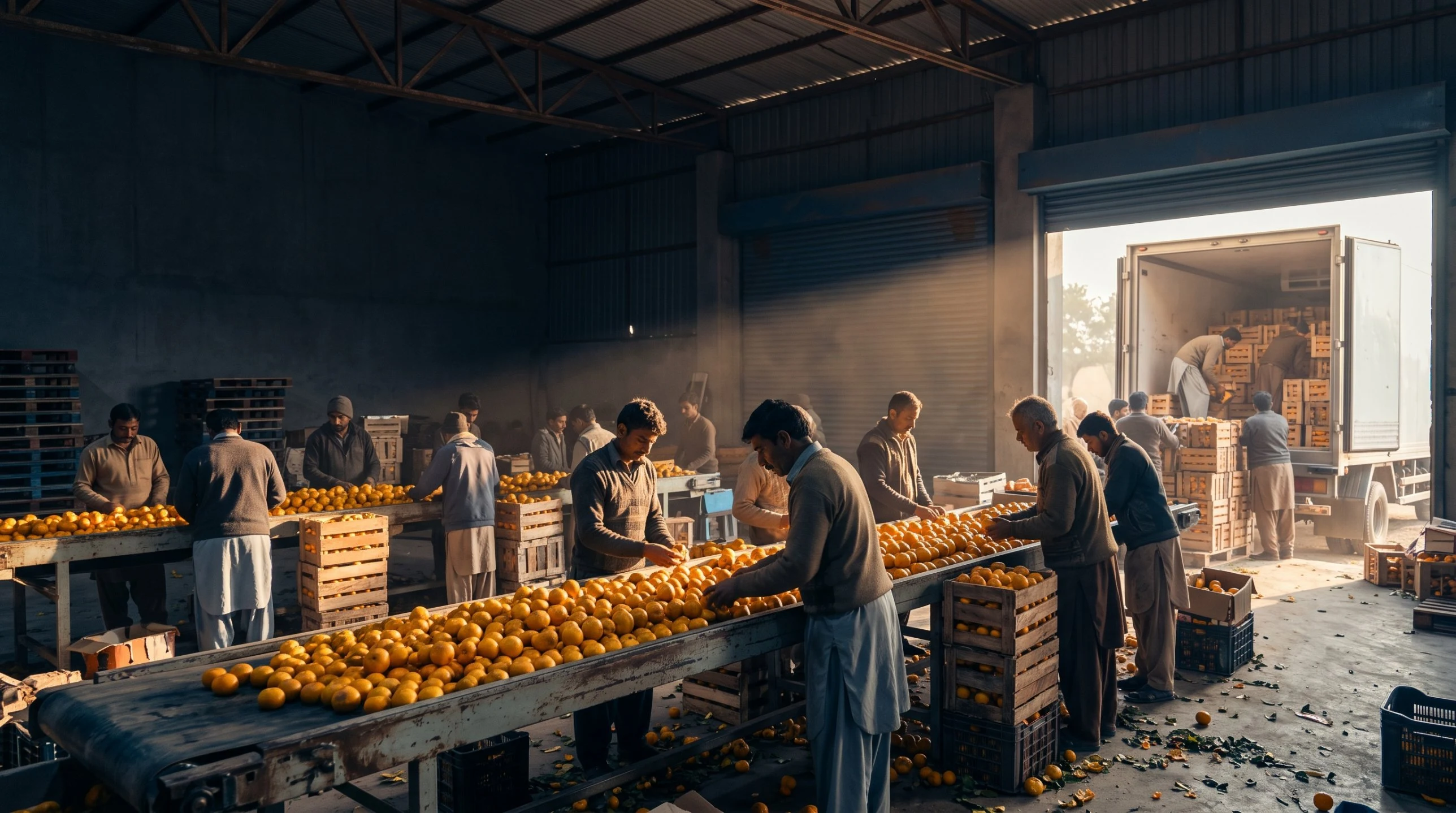
Pakistan produced over 2.1 million tons of kinnow, more than 1.8 million tons of mangoes, and around 12 million tons of potatoes in FY2026. Its total fresh fruit and vegetable exports for that same year came to roughly $471 million — about $308 million in fruit, $163 million in vegetables. The gap between what Pakistan grows and what it actually gets onto a ship isn't a production problem. Industry estimates put post-harvest losses across the fruit and vegetable supply chain at 30% to 40%. The bottleneck is cold chain infrastructure, and that makes this a logistics story as much as an agricultural one.
The Numbers Behind the Gap
A September 2026 industry assessment lays out the opportunity in blunt terms: across 23 countries where Pakistani exporters have already shipped or identified demand, estimated annual import demand for just three products — mangoes, kinnow, and potatoes — runs to roughly 5.89 million tons: about 548,000 tons of mangoes, 2.37 million tons of kinnow, and 2.97 million tons of potatoes. Current Pakistani export volumes in these categories are a small fraction of that demand, even before accounting for the output lost to spoilage before it ever reaches a port.
Two industry roadmaps put concrete growth targets on the opportunity. SE Fruits & Vegetables' CFO projects Pakistan could build a $1 billion annual fruit, vegetable, and value-added export sector within two to three years. A separate roadmap from the Pakistan Fruit and Vegetable Exporters and Merchants Association, developed with the Trade Development Authority of Pakistan, targets growth from roughly $700 million to $2 billion within three years.
What's Actually Missing
Every roadmap we reviewed names the same set of gaps: cold-chain infrastructure (refrigerated storage and transport that keeps produce at the right temperature from farm to port), sorting and grading capacity, proper packaging standards, and phytosanitary compliance systems that meet import-market requirements. None of these are new problems for Pakistani agriculture, but the scale of the demand now being quantified — nearly 6 million tons of addressable annual demand in just three product categories — makes the cost of leaving them unsolved much clearer than it used to be.
One company's own trajectory illustrates both the problem and the opportunity: SE Fruits & Vegetables exported about 5,115 tons in FY2026 (3,600 tons kinnow, 1,515 tons mangoes) but is targeting roughly 30,327 tons in FY2027 and 35,953 tons in FY2028 — a six-to-seven-fold increase in two years. That kind of jump is only achievable if cold storage, packing, and transport capacity scale alongside it.
| Metric | Current (FY2026) | Target |
|---|---|---|
| Total Fruit & Vegetable Exports | ~$471 million | $1–2 billion within 2–3 years |
| Post-Harvest Losses | 30–40% of output | Reduction via cold chain investment |
| Addressable Export Demand (3 crops, 23 markets) | ~5.89 million tons/year | Fraction currently captured |
What This Means for Exporters and Freight Partners Right Now
- Exporters scaling toward these targets need reefer capacity booked well ahead of peak harvest windows — kinnow and mango seasons are time-sensitive, and spoilage risk rises sharply with any delay between harvest and cold storage or shipment.
- Investment in sorting, grading, and packaging infrastructure pays for itself in reduced losses before it pays for itself in new export volume — the 30-40% loss figure represents product that never earns a dollar either way.
- Phytosanitary compliance should be built into the export process early, not treated as a final-stage hurdle — new markets identified in the 23-country demand assessment will have their own specific requirements.
- Forwarders handling perishables should expect rising demand for cold chain and reefer services as these roadmaps move from targets to shipped volume over the next two to three years.
Our ocean freight team and air freight specialists work with perishable exporters on cold chain logistics and time-sensitive routing, the same operational focus we bring to the bulk and documentation challenges we've covered in our recent look at Pakistan's rice export boom.
Conclusion: The Demand Is Already There
What makes this moment different from previous calls to fix Pakistan's cold chain gap is the specificity of the numbers now attached to it: nearly 6 million tons of quantified annual demand across 23 markets, concrete multi-year growth targets from both individual exporters and industry associations, and a clear diagnosis that production volume was never the limiting factor. For freight and logistics providers, that's a demand signal worth planning around now — cold chain and reefer capacity, phytosanitary documentation support, and time-sensitive routing for perishables are likely to be in materially higher demand over the next two to three years if even part of these targets are met.
At Falcon Global Logistics, we help exporters move time-sensitive perishable cargo with the cold chain reliability international buyers require. Contact us today to discuss cold chain and reefer logistics for your export shipments.