CPEC just changed shape, and most of the coverage has focused on the politics of it rather than what it means for anyone actually moving cargo. At the 14th Joint Cooperation Committee meeting in Beijing in September 2025, the China-Pakistan Economic Corridor was formally reorganized around five new pillars — growth, livelihood, innovation, green development, and openness — shifting the emphasis away from the power plants and expressways that defined its first decade. A revised CPEC Long-Term Plan is due this fiscal year, which gives Pakistan roughly a two-year window to actually build the logistics capability the new phase assumes exists. At Falcon Global Logistics, we track this kind of policy shift closely because it directly shapes what's realistic to promise clients moving cargo through this corridor over the next few years.
From Infrastructure-Building to "Openness"
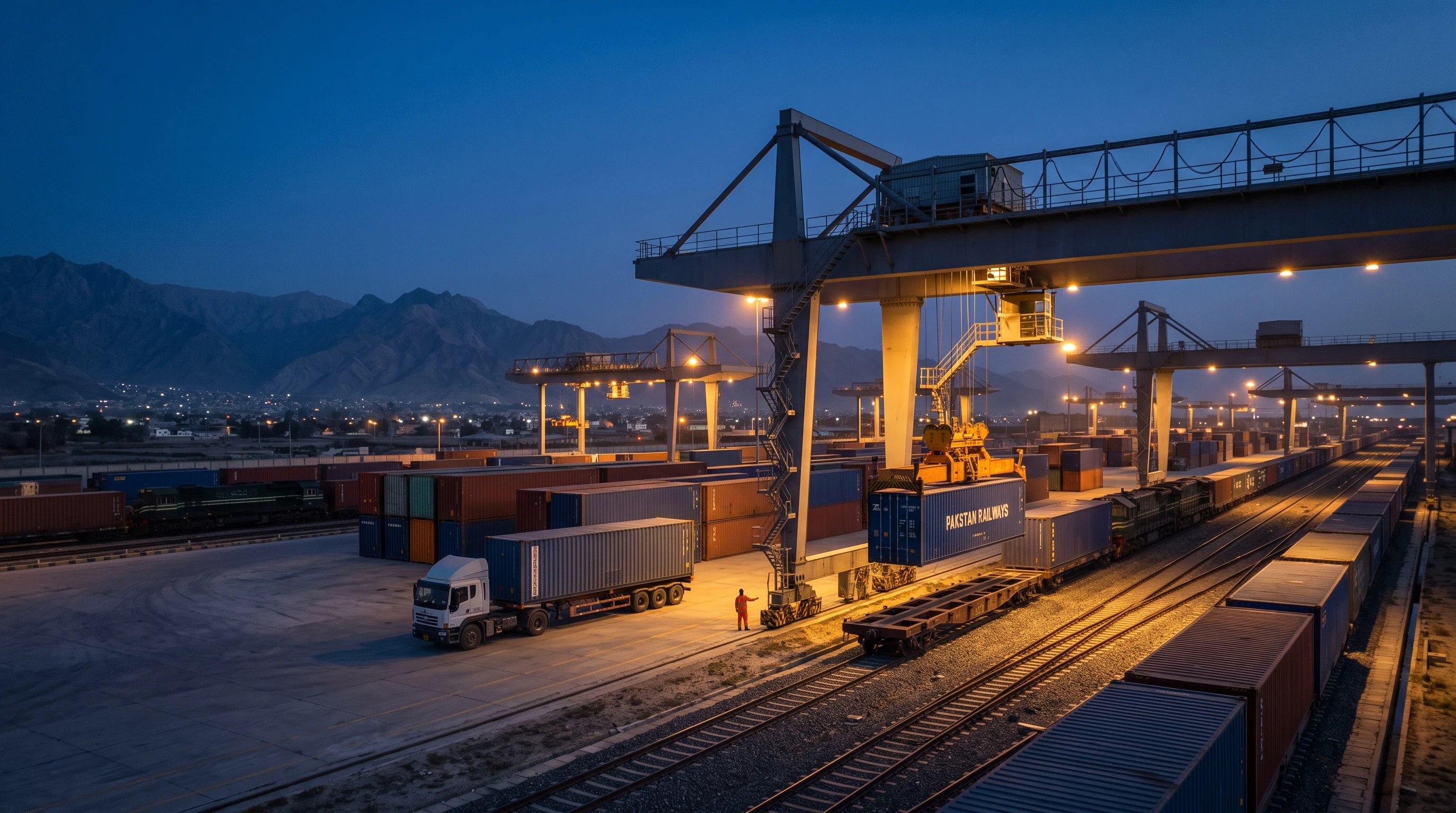
CPEC's first decade was about physical assets: power generation, the Karakoram Highway upgrade, Gwadar Port construction. CPEC 2.0's "Openness Corridor" pillar is a different kind of project — it's about trade facilitation, meaning the systems and processes that let goods actually flow through the infrastructure that's already been built. That's a meaningful shift for freight forwarders and importers, because it means the next phase of CPEC is measured less by ribbon-cuttings and more by whether a shipment can clear a border in hours instead of days.
The Competition Pakistan Is Actually Racing
It's worth understanding the scale of what a well-run overland corridor can move, because it puts Pakistan's opportunity — and its current gap — in perspective. China's Western Land-Sea Corridor, a competing overland trade route connecting western China to Southeast Asia, moved 1.425 million containers last year, up 48% year-on-year. That's the kind of volume growth that happens when customs digitization, rail capacity, and multimodal handling are all functioning together. CPEC's overland route through Khunjerab Pass and the Karakoram Highway serves a different geography, but the comparison illustrates what's achievable when the systems, not just the roads, are in place.
What's Actually Still Missing
The gaps aren't secret — they're the specific items flagged as priorities for this two-year window:
- Digital customs infrastructure at Gwadar is still largely absent, meaning clearance there still depends heavily on manual, paper-based processing rather than the automated risk-based systems that make "hours, not days" clearance realistic.
- ML-1 rail upgrade — the Main Line-1 railway modernization connecting Karachi to Peshawar — remains incomplete, which keeps a structural bottleneck in place for any multimodal (rail-to-road, rail-to-port) cargo movement along the corridor.
- Bonded warehousing and storage capacity at port facilities is still thin relative to what a genuinely open trade corridor would need to buffer volume without demurrage penalties piling up.
- Integrated border management — a single coordinated system across customs, quarantine, and security agencies at border crossings — is called out as needed dedicated infrastructure, not yet fully in place.
On the positive side, Gwadar's new international airport was handed over to the Pakistan Airports Authority following its late-2024 inauguration, which is a genuine piece of the puzzle now in place — infrastructure delivery hasn't stalled entirely, it's specifically the trade-facilitation and digital-systems layer that's lagging behind the physical build-out.
| Requirement | Current Status | Why It Matters for Cargo |
|---|---|---|
| Digital customs (Gwadar) | Largely absent | Blocks "hours not days" clearance target |
| ML-1 rail upgrade | Incomplete | Keeps a multimodal bottleneck in place |
| Bonded warehousing at ports | Limited capacity | Raises demurrage risk on volume spikes |
| Gwadar international airport | Handed over, operational | One completed piece of the puzzle |
What This Means for Importers and Exporters Right Now
This is a corridor worth watching and planning around, not one to bet a tight delivery schedule on today. For businesses already moving cargo on China-Pakistan lanes — a topic we covered in detail in our post on shipping trends after the new trade policies — the practical takeaway is to keep building in buffer time at the border and port stages until the digital customs and rail pieces are demonstrably in place, not just announced. Falcon Global Logistics tracks CPEC policy developments and infrastructure milestones as part of how we plan import/export routing for clients on this corridor, so timelines reflect what's actually operational rather than what's on a roadmap.
Our clearing and forwarding team also keeps a close eye on how Pakistan's broader export push — covered in our post on the new industrial export policy — interacts with CPEC 2.0's openness pillar, since both are aimed at the same underlying goal of making Pakistan easier to trade through.
Conclusion: A Two-Year Test, Not a Two-Year Guarantee
CPEC 2.0's "Openness Corridor" pillar is the right ambition — a trade corridor is only as useful as the systems that let cargo actually move through it quickly. Whether Pakistan closes the digital customs and rail gaps within the stated two-year window will determine whether this corridor starts competing meaningfully with alternatives like China's Western Land-Sea Corridor, or continues to lag behind its own infrastructure. Either way, it's a story worth tracking closely if your business touches this trade lane.
At Falcon Global Logistics, we build realistic routing and timeline plans around where CPEC infrastructure actually stands today, not where policy says it will stand tomorrow. Contact us today to plan your China-Pakistan trade lane with current, accurate timelines.