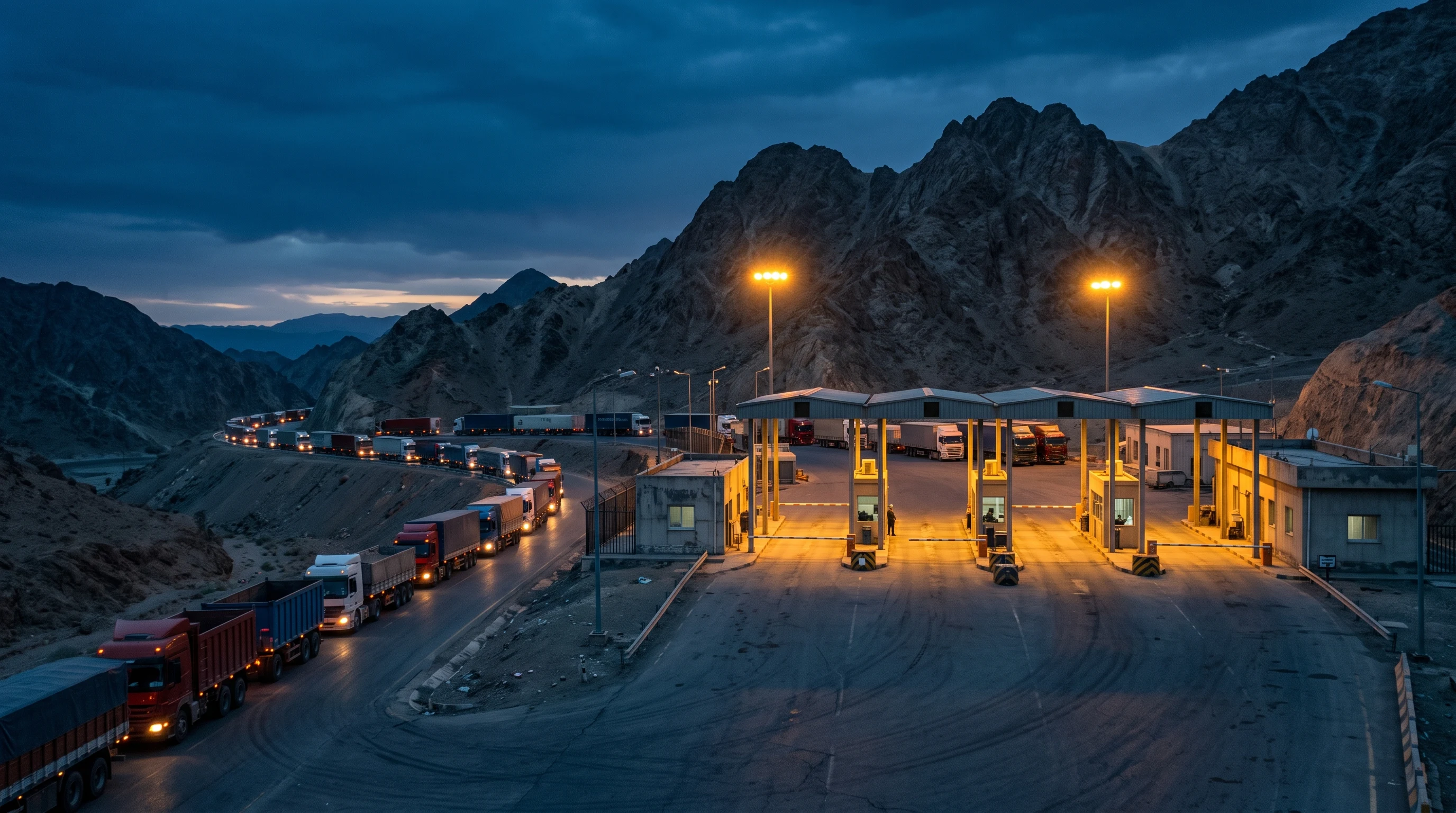
Afghan transit trade moving through Pakistan — cargo destined for landlocked Afghanistan that passes through Pakistani ports and border crossings under the two countries' transit trade arrangement — has collapsed to a fraction of what it was just three years ago. This isn't a temporary dip tied to this month's headlines. It's a multi-year structural decline that a border closure accelerated but didn't create. At Falcon Global Logistics, we think anyone with cargo exposure to this corridor needs to understand the difference, because the two scenarios call for completely different business decisions.
The Numbers: A Corridor That's Lost 95% of Its Volume
The trajectory is stark. In FY2021, as the Taliban returned to power, transit trade volume stood around $5 billion, roughly 89,000 containers. It briefly recovered and peaked in FY2023 at $6.7 billion and 102,886 containers. From there, the decline was sustained and severe: FY2024 volume fell to 54,114 containers, FY2025 dropped further to $1.36 billion and 42,959 containers, and FY2026 has come in at just $367 million and 11,592 containers. From the FY2023 peak to today, that's roughly a 95% collapse in container volume.
| Fiscal Year | Trade Value | Containers |
|---|---|---|
| FY2021 | ~$5.0 billion | ~89,000 |
| FY2023 (peak) | $6.7 billion | 102,886 |
| FY2024 | — | 54,114 |
| FY2025 | $1.36 billion | 42,959 |
| FY2026 | $367 million | 11,592 |
The Border Closure Isn't the Root Cause
Pakistan closed the border in October 2025 citing security concerns, and it's tempting to treat that as the explanation for these numbers. The trade data says otherwise — the decline from the FY2023 peak was already well underway before the closure took effect. Trade analysts covering this corridor have been direct about the actual driver: "The border closure did not initiate Kabul's search for alternative trade routes. Rather, it marked the culmination of a strategy the Afghan Taliban had already begun to reduce Afghanistan's dependence on Pakistani ports." Afghanistan has been deliberately building out trade routes through Iran over recent years specifically to reduce reliance on Pakistani ports and transit corridors — a strategic choice, not a reaction to the border closure.
Current Border Tension Adds a Fresh Layer of Uncertainty
Beyond the underlying structural shift, the border situation has remained unsettled through September 2026, with continued friction between the two countries over security concerns each side has raised about the other. We won't editorialize on that dispute here — it's outside what a freight and logistics blog should weigh in on — but the practical reality for cargo owners is that it adds near-term unpredictability on top of an already-declining baseline. Even if the immediate tension eases, the structural shift toward alternative routes documented above doesn't reverse on the same timeline.
Who Actually Bears the Cost
The economic impact of this decline isn't abstract. Higher logistics costs on reduced-volume alternative routes feed into inflation, and the impact falls disproportionately on communities whose employment and local economies depend on this corridor — on both sides of the border. For a trade relationship that once moved over 100,000 containers a year, a drop to roughly 11,000 represents real job and income loss in the border regions that historically served this trade, not just a line item in a customs report.
What This Means If You Move Cargo on This Corridor
- Don't plan around a reopening restoring prior volumes. Even in scenarios where border tensions ease, Afghanistan's deliberate shift toward Iranian trade routes is an investment decision, not a temporary preference — it doesn't unwind quickly.
- Treat any remaining APTTA-route business as a shrinking, not stable, revenue line and plan capacity and staffing accordingly rather than assuming current reduced volumes represent a new steady state.
- If you have alternative routing options for Afghanistan-bound cargo, this is the environment to have those relationships and documentation ready rather than reactive, given how unpredictable the border situation has proven over the past year.
- Watch policy announcements about border reopening as one input, not the whole picture. A reopening addresses the acute disruption; it doesn't address the multi-year strategic shift that was already underway before the closure.
Our clearing and forwarding team tracks developments on this corridor alongside Pakistan's other trade routes, and our import/export specialists can help businesses with Afghanistan-linked cargo build realistic contingency plans rather than waiting on a recovery that the underlying trade data doesn't currently support.
Conclusion: A Structural Shift, Not a Pause
Afghan transit trade through Pakistan has gone from $6.7 billion to $367 million in three years — a decline that started before the current border closure and reflects Afghanistan's own strategic pivot toward alternative routes. Current border tensions add near-term uncertainty on top of that trend, but they're not the root explanation for it. Any business still exposed to this corridor should be planning around a structurally smaller trade relationship, not waiting for conditions to return to where they were in 2023.
At Falcon Global Logistics, we help clients build routing strategies based on where trade corridors actually stand, not where they used to be. Contact us today to review your regional routing options and contingency planning.